
Installer interview: Jason Rogan
Hear from installer, Jason Rogan, on his experience as a heating engineer and his journey through renewable tech.

Heat pumps are becoming increasingly popular in the UK, even in older properties. Installer Jason Rogan tells us how he’s supported a 17th-century property with low-carbon heating.
From understanding the intricacies of heat pump systems to ensuring seamless integration into customers’ homes, heat pump installers play a crucial role in shaping a greener future. We interview Jason Rogan, Renewables Division Manager at C. P. Jefferies Ltd, to hear his journey and a sneak peek into a recent 17th-century project.
Q, So, Jason, please can you share a bit about you and your background? How did you get into the heating industry?
A, In early 2002, I began learning about plumbing and heating and laid a career path out involved with the industry. I worked for a prestigious company between 2005-2013, where I learned and gained experience in the heating industry, and more so around renewable energy sources and their purpose in the domestic market. During this time, I won awards for installations and worked on some very interesting projects.
Since then, I’ve been involved in larger projects with my current employer, C. P. Jefferies Ltd., all the while expanding our knowledge and sharing this knowledge with aspiring heating engineers... I consider myself to be passionate about the industry and where it is heading, with a constant need to learn and know more.
Q, Please can you share some information about the company you work for and your role within the organisation?
A, C. P. Jefferies Ltd, as a company, has been around for an extremely long time. I joined the company in 2018 and began to set up the renewables division. Initially, it was hard to gain traction due to the lack of awareness and the knowledge that we could cater to such systems. We soon recognised our potential, and customers became more aware of the company and our abilities.
We have grown over the years to include more engineers with knowledge of renewable systems, and likewise, electrical systems associated with PV, EV charging, and home energy storage systems.
Q, You’ve recently installed a heat pump at a grade II listed property, what was your involvement in the project?
A, I was first approached by the architect of the project for a proposal on upgrading the heating system based on the property requirements and requests from the tenant, homeowner and overall estate… My involvement began with providing a specification that would fulfil the heating and hot water needs of an aged property that was in the process of being historically modified. The property was in a state of disrepair and required careful consideration in the approach to best satisfy the homeowner/tenant.
Q, Please can you share some details of the project and property?
A, The property is a Grade II listed building from the late 17th century. It has a stone wall construction and has surpassed the test of time throughout the years with its bold, solid standing within the estate it resides in. The 4-bed property has had various renovations throughout its life, such as having a Cotswold stone-slate roof and a 20th-century glazed door.
During the renovation project, the property was stripped of aged, non-restorable materials, and then subsequently restored with modern alternatives - whilst retaining the graded listing it has upon it. It was deemed suitable that a sprayed-on, permeable, breathable, and insulative layer was applied to the internal stone walls of the building, which reduced the heat losses massively whilst maintaining the breathability of an aged building. This was the main element that allowed a renewable energy source to be applied to the building. dMVHR units fans were installed to assist with dampness levels should they arise.
Q. How did you specify the right system for the job?
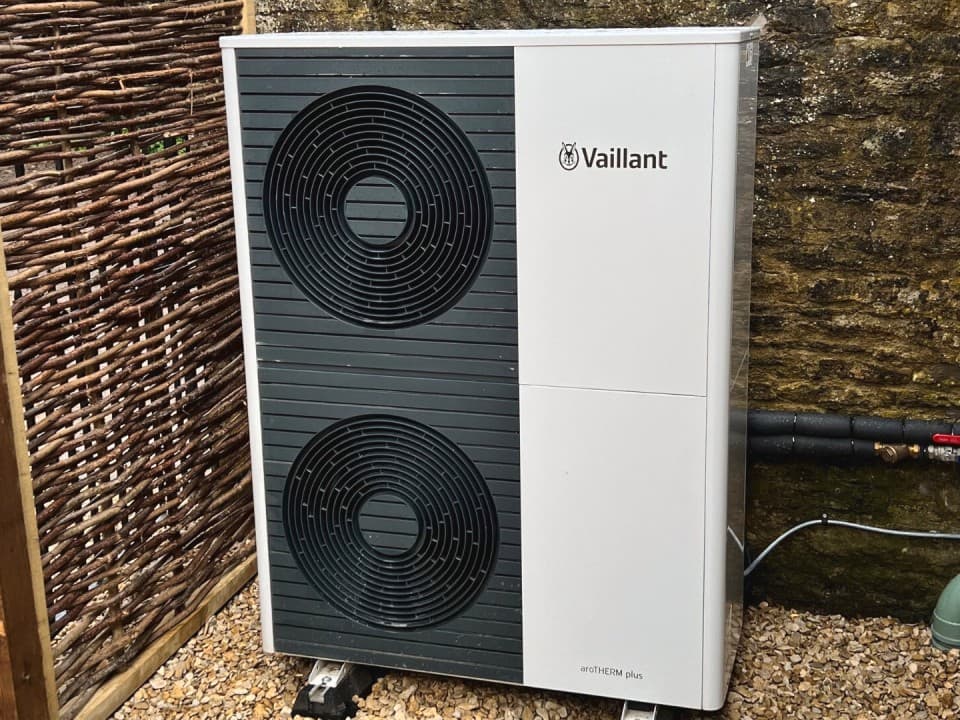
A, After performing heat loss calculations and liaising with the architect, we provided a proposal and specification that would benefit both the property and end user. We summarised that a 12kW Vaillant aroTHERM plus air source heat pump (ASHP) system would be installed and that it would satisfy both the hot water and heating needs.
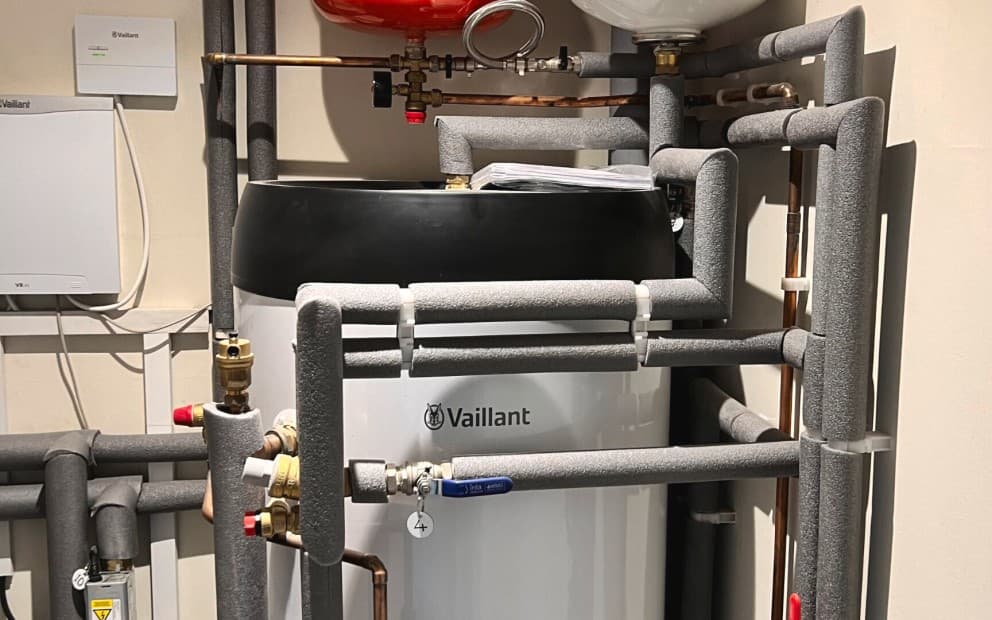
Alongside the ASHP, we installed a Vaillant 250 litre DHP UV HP cylinder, 45 litre buffer cylinder, full radiator system and Vaillant sensoCOMFORT controls to zone the radiators within the property.
The heating system that was installed was a contemporary standard panel type radiator system, sized, specified and provided to maintain comfort conditions when being supplied with a low-grade heat such as that being produced from an ASHP system… Since the system has been installed, we have had several comments on the performance of the system and that the system has maintained comfort conditions higher than normal, especially during peak winter.
Q, Did you face any challenges with the project?
A, The main challenges were to ensure that considerations were made at every visit due to the properties listing and bats being present. We had to consider the pipe routing and the locations of the radiators to not interfere with existing structures or the walls that could support the weight.
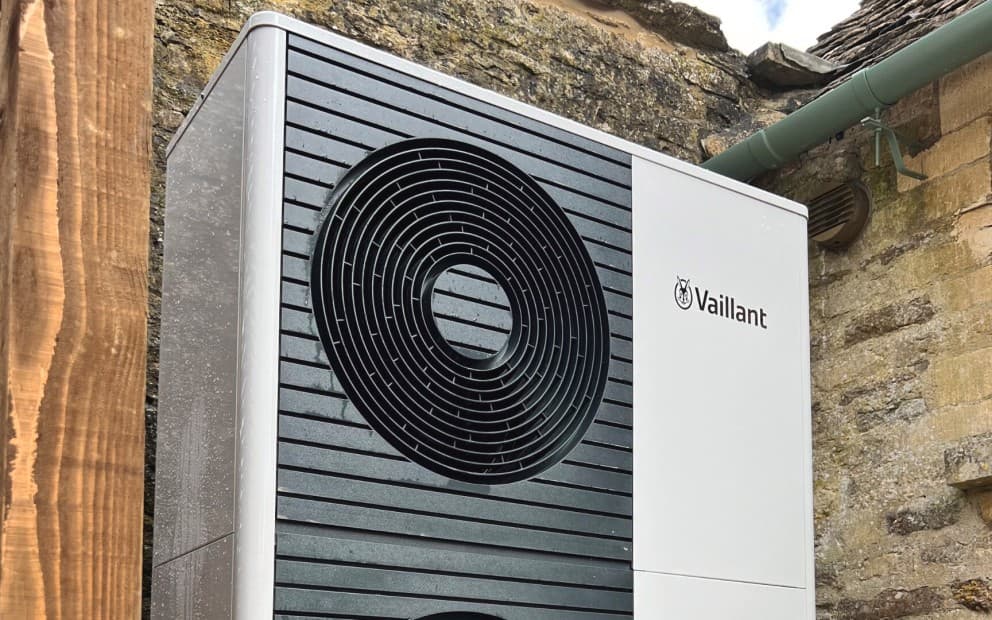
Noise levels were kept to a minimum, not only during construction but also post-completion. That was another reason for selecting the Vaillant aroTHERM plus!
Q, How long have you been working with Vaillant appliances?
A, I have used Vaillant products for several years, from the early Vaillant ASHP units to the current ranges. Since being with C.P. Jefferies, I have endorsed the Vaillant brand more due to quality, technical support and assistance.
Q. Have you been on any Vaillant training courses?
A, I have been on a few training courses personally, but my engineers have been on more. There is always room to learn more and further develop knowledge and experience.
Q, Why choose Vaillant?
A, The biggest reason for choosing Vaillant is the quality of the product. All other reasons revolve around aesthetics, sound levels, heat pump performance criteria, controllability, and ease of installation, to name a few. Vaillant will be a system preferred over most if the level of support is maintained, product knowledge is readily available, and if the products evolve to stay abreast of others, considering the now competitive nature of the market and its counterparts.